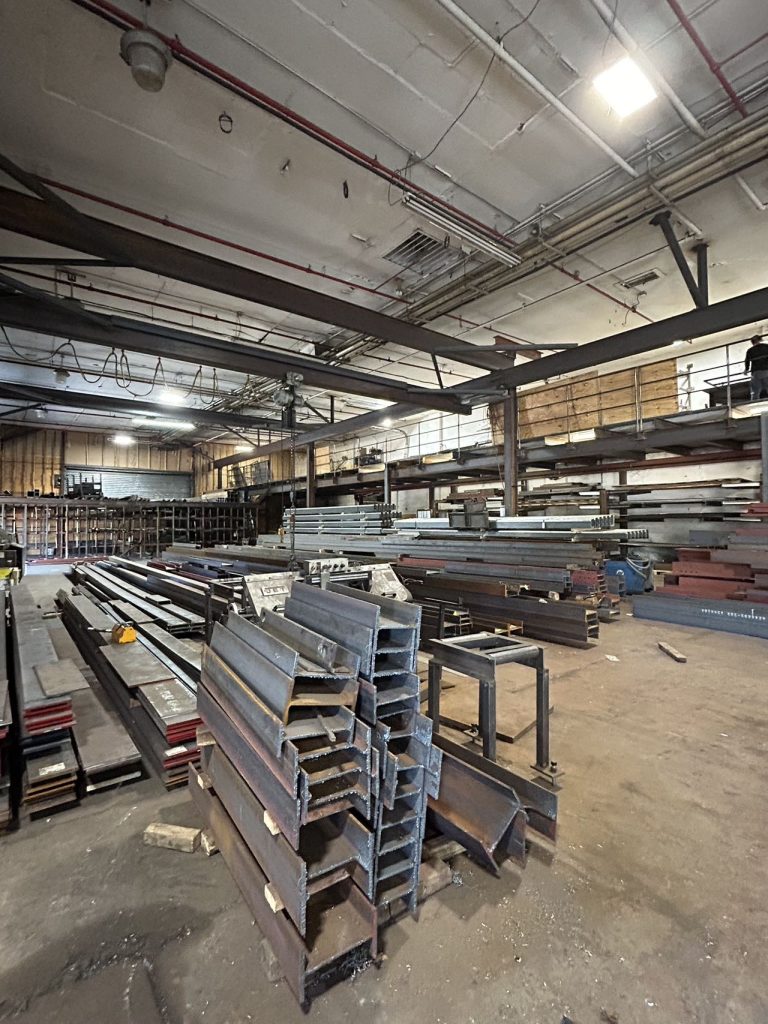
Walk into any steel yard in New York City and you'll find racks of steel in dozens of different profiles — L-shapes, I-shapes, tubes, pipes, flat bars, sheets, and more. If you're not sure what you're looking at or which shape fits your project, this guide is for you.
Understanding structural steel shapes helps you specify your order accurately, communicate clearly with your fabricator, and avoid paying for the wrong material. Here's a plain-English breakdown of the most common shapes you'll encounter.
Why Steel Shape Matters
Each steel shape is engineered with a specific cross-sectional geometry that determines how it handles different types of loads. A wide flange beam resists bending along its strong axis. An angle provides corner reinforcement and bracing. A hollow section resists twisting better than an open shape. Choosing the wrong shape for a structural application can lead to deflection, failure, or rejection during inspection — so it's worth understanding the basics before you order.
If you're unsure which shape your project requires, describe the application to us — where it's going, what it supports, and any engineer specs — and we'll point you to the right product from our inventory.
Angles (L-Shapes)
Steel angles are L-shaped cross-sections available in equal-leg and unequal-leg configurations. They're one of the most versatile shapes in the yard and among the most commonly ordered by NYC contractors.
Common uses:
- Shelf support brackets and ledger angles
- Lintels above door and window openings
- Bracing and framing connections
- Corner guards and edge protection
Angles are specified by leg size and thickness — for example, L3×3×1/4 means a 3-inch by 3-inch equal-leg angle, 1/4 inch thick.
Wide Flange Beams (W-Shapes)
Wide flange beams — also called W-shapes or I-beams — are the primary structural shape in building construction. Their wide, flat flanges connected by a vertical web give them excellent bending resistance, making them the standard choice for floor beams, columns, and long-span framing.
Wide flanges are specified by their nominal depth and weight per foot — for example, W8×31 means an 8-inch deep section weighing 31 pounds per linear foot. Heavier sections of the same depth have thicker flanges and webs and carry greater loads.
Channels (C-Shapes)
Steel channels have a C-shaped cross-section — two flanges extending from one side of a web. They're commonly used where you need a beam but only have access from one side, or where you want a channel to receive another member.
Common uses for channels:
- Purlins and girts in steel-framed buildings
- Framing around openings in floors and roofs
- Support rails and guides for sliding doors
- Trailer frames and equipment supports
Standard channels (C-shapes) have sloped inner flanges; MC-shapes (Miscellaneous Channels) have parallel flanges and are easier to connect to other members.
Flat Bars
Flat bars are rectangular steel bars available in a wide range of widths and thicknesses. They're one of the most flexible and widely used shapes in fabrication — easy to cut, drill, bend, and weld. In NYC construction, flat bar is heavily used for gussets, connection plates, stair nosing reinforcement, and custom brackets.
Flat bar and plate are often confused. Flat bar is typically narrower (under 8 inches wide) and sold by the linear foot. Plate is wider and sold by the square foot or by weight. For most fabrication and bracket work, flat bar is what you want.
Hollow Structural Sections (Tubing)
Hollow Structural Sections (HSS) come in square, rectangular, and round cross-sections. Because they're closed shapes, they resist torsion (twisting) much better than open shapes like angles or channels — making them the preferred choice for columns, frames, and structures subject to lateral loads.
HSS applications:
- Columns in light structural frames
- Gate and fence framing
- Handrail posts and guard rail systems
- Furniture and architectural metalwork
Pipe vs. Tubing: What's the Difference?
This is one of the most common sources of confusion at the steel yard. Here's the short answer: pipe is specified by nominal pipe size (NPS) and schedule (wall thickness), based on standards originally designed for fluid transport. Tubing (HSS or mechanical tubing) is specified by its actual outside dimension and wall thickness.
For structural applications — columns, handrail posts, frames — use HSS tubing, which is manufactured to structural tolerances and available in structural grades. Pipe is fine for fluid applications and is sometimes used for railings, but it's not a direct substitute for structural HSS.
Sheets and Plates
Steel sheet and plate are flat-rolled products specified by thickness. Sheet is typically under 3/16 inch thick; plate is 3/16 inch and thicker. In fabrication, plate is used for base plates, gussets, connection hardware, and custom flat parts. Sheet is used for cladding, decking, and thin-gauge applications.
Iron Wei Steel Corp stocks carbon steel sheet and plate in common thicknesses and can cut to size in-house. We also carry stainless sheet and aluminum sheet for specialty applications.
How to Order: What Information You Need
When calling or visiting to order structural steel, have this information ready:
- Shape: Angle, beam, channel, tube, pipe, flat bar, sheet, or plate
- Size: Dimensions using the standard designator (e.g., L3×3×1/4, W8×31, HSS4×4×1/4)
- Grade: A36 for most structural work; A500 for HSS; 304 or 316 for stainless
- Length: How long each piece needs to be (stock length or cut-to-size)
- Quantity: Number of pieces or total linear footage
If you're not sure of the exact designation, describe the application and we'll help you identify the right shape and size from our inventory.
The Bottom Line
Structural steel shapes aren't complicated once you understand the basic categories. Angles and flat bar for connections and brackets, beams for spanning and bending loads, channels for framing, HSS for columns and frames, plate for flat components. Iron Wei Steel Corp stocks all of these shapes at our Jamaica, Queens facility and can cut, drill, and weld to your specifications.
Stop by at 110-40 Dunkirk St, Jamaica, NY 11412 or call (929) 447-5588 and tell us what you're building.
Not Sure Which Shape You Need?
Describe your application and we'll identify the right shape from our inventory. Iron Wei Steel Corp — Jamaica, Queens.